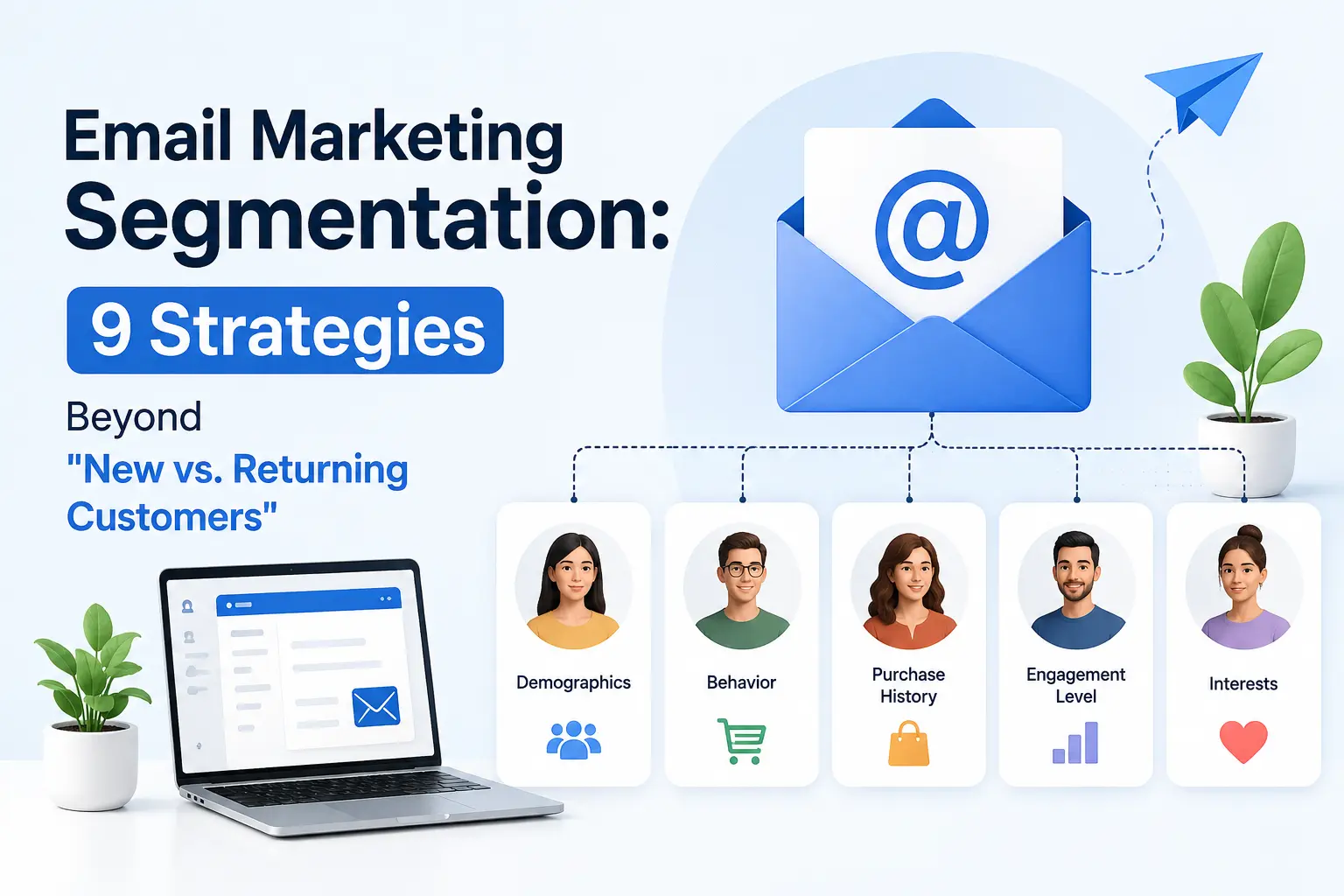
Email Marketing Segmentation: 9 Strategies Beyond “New vs. Returning Customers”
If your email marketing segmentation strategy stops at “new subscribers” and “returning customers,” you’re leaving open rates, click-through rates, and revenue on the table. That basic split was useful in 2015. Today’s inboxes are smarter, subscribers expect relevance, and email service providers reward or punish you based on engagement signals tied to how well-targeted your sends actually are.
This guide breaks down nine advanced segmentation strategies that go far beyond the new-vs-returning binary, along with how to implement each one without needing an enterprise martech budget.
Why Basic Segmentation Isn’t Enough Anymore
New vs. returning tells you almost nothing about why someone hasn’t purchased again, what they actually want, or when they’re most likely to convert. Treating a first-time buyer who spent $300 the same as one who bought a $12 add-on ignores the single biggest driver of email revenue: relevance.
Effective email marketing segmentation increases relevance, and relevance is what moves the metrics that matter — open rate, click-through rate, unsubscribe rate, and ultimately, revenue per email sent.
9 Advanced Email Segmentation Strategies
1. Purchase Behavior Segmentation
Group subscribers by what they actually bought, not just whether they bought:
- Product category or SKU
- Average order value (AOV) tiers
- Purchase frequency (one-time, occasional, habitual)
- Cart abandonment vs. completed checkout
This lets you send category-specific promotions instead of generic “we miss you” blasts.
2. RFM Segmentation (Recency, Frequency, Monetary)
RFM scoring ranks customers on three variables how recently they bought, how often, and how much they spent. It’s one of the most reliable segmentation models in email marketing because it identifies your highest-value customers and flags who’s at risk of churning, without needing predictive software.
3. Engagement-Based Segmentation
Segment by how subscribers interact with your emails:
- Highly engaged (opens/clicks in last 30 days)
- Dormant (no engagement in 90+ days)
- Never engaged (never opened a single email)
This directly protects sender reputation. Sending fewer emails to disengaged segments improves deliverability for your entire list.
4. Browse and Website Behavior Segmentation
Use on-site behavior pages viewed, products browsed, search queries, time on site to segment subscribers who haven’t purchased yet but have shown clear intent. This is especially powerful for triggering behavioral email flows like browse abandonment.
5. Customer Lifecycle Stage Segmentation
Map subscribers to a lifecycle stage rather than a binary label:
- Lead / subscriber (no purchase yet)
- First-time buyer
- Repeat buyer
- Loyal / VIP customer
- Lapsed or at-risk customer
Each stage warrants a different message, tone, and offer.
6. Demographic and Firmographic Segmentation
For B2C: age, gender, location, life stage. For B2B: company size, industry, job title, tech stack. This segmentation type works best combined with behavioral data rather than used alone.
7. Psychographic and Interest-Based Segmentation
Built from quiz responses, preference centers, content clicks, or survey data. Interest-based segmentation lets you send content-driven emails (not just promotional ones) that build trust ahead of a purchase decision.
8. Predictive Segmentation
Using machine learning or built-in ESP tools to segment by predicted behavior:
- Predicted next purchase date
- Predicted churn risk
- Predicted lifetime value (LTV)
Most major ESPs (Klaviyo, HubSpot, Salesforce Marketing Cloud) now offer this natively, so you don’t need a data science team to use it.
9. Channel and Device Preference Segmentation
Segment by preferred device (mobile vs. desktop) or cross-channel behavior (email-only vs. email-plus-SMS engagers). This informs both design decisions and channel mix in your campaigns.
How to Combine Segments for Maximum Impact
The real power of email marketing segmentation isn’t any single segment it’s layering them. For example:
High AOV + Dormant + Mobile-first = a win-back campaign with a strong offer, mobile-optimized design, and urgency-driven subject line.
Start with two or three high-impact combinations rather than trying to build every segment at once.
Getting Started: A Practical Rollout Plan
- Audit your current data confirm what behavioral and transactional data your ESP is actually capturing.
- Pick 2–3 segmentation models from this list that match your business (RFM and engagement-based are the best starting point for most brands).
- Build automated flows around each segment rather than relying on manual list pulls.
- Test and measure open rate, CTR, and revenue per recipient by segment not just in aggregate.
- Refine quarterly as customer behavior and product catalog evolve.
Final Thoughts
Moving beyond new vs. returning customers isn’t about complexity for its own sake — it’s about sending the right message to the right person at the right time. Start with RFM and engagement-based segmentation if you’re just beginning, then layer in behavioral and predictive segments as your data matures. The result: higher engagement, better deliverability, and more revenue per email sent.
Suggested internal links: link to related posts on “email automation flows,” “reducing email churn,” and “RFM analysis for ecommerce.” Suggested image alt text: “email marketing segmentation strategies diagram”