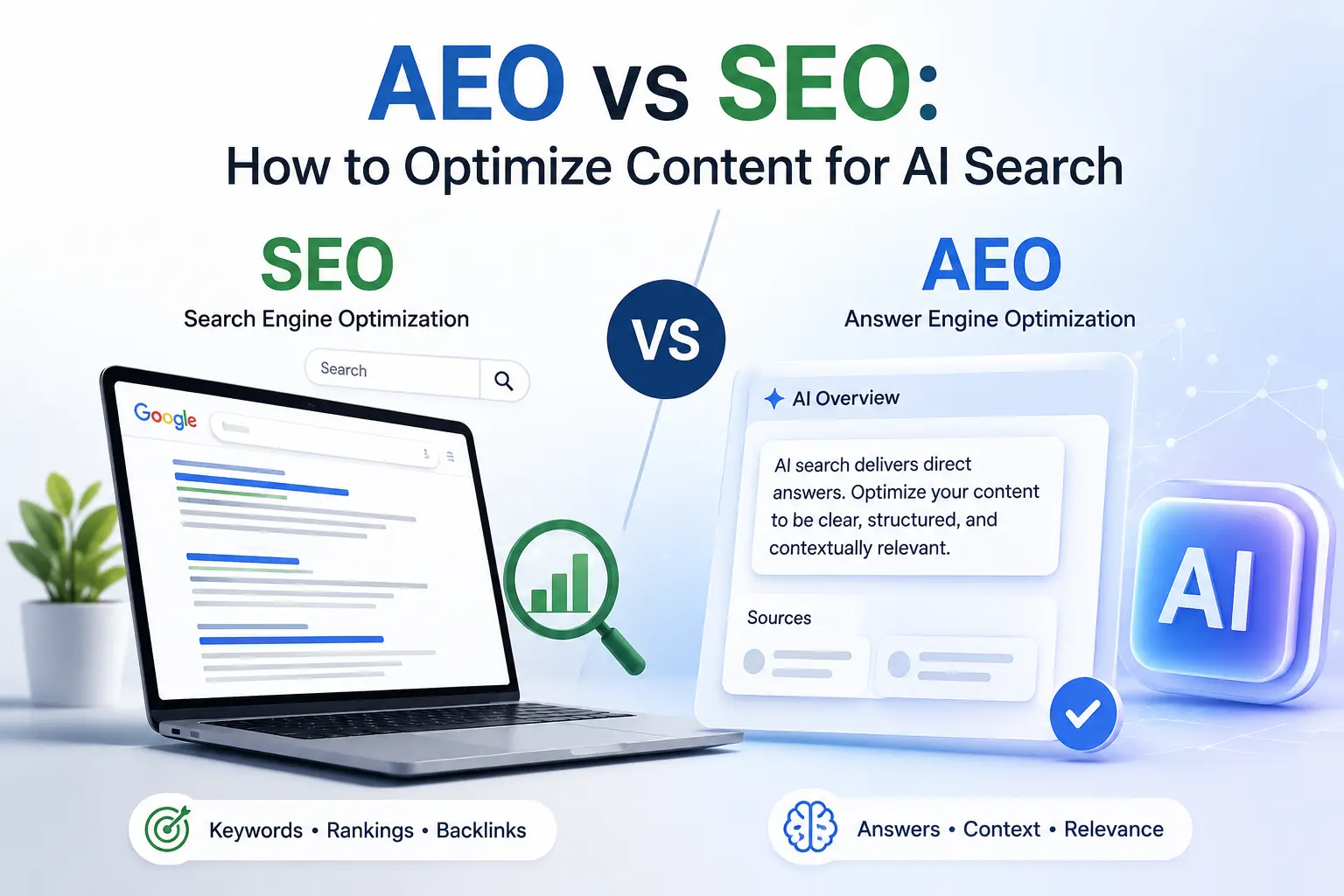
AEO vs SEO: How to Optimize Content for AI Search
Search behavior is changing fast. People no longer just type keywords into Google they ask full questions to ChatGPT, Gemini, Perplexity, and AI Overviews, expecting a direct answer instead of a list of blue links. This shift has created a new discipline sitting alongside traditional SEO: AEO, or Answer Engine Optimization.
If you’re a content marketer, business owner, or SEO strategist, understanding AEO vs SEO and how to optimize for both is now essential to staying visible online. This guide breaks down what each one means, how they differ, and the exact steps to optimize your content for AI search in 2026.
What Is SEO?
Search Engine Optimization (SEO) is the practice of optimizing web content so it ranks higher in traditional search engine results pages (SERPs), like Google and Bing. SEO focuses on:
- Keyword research and placement
- Backlink building and domain authority
- Technical site health (site speed, mobile-friendliness, crawlability)
- On-page elements like title tags, meta descriptions, and headers
- User engagement signals (click-through rate, dwell time)
The goal of SEO is simple: rank in the top positions so users click through to your website.
What Is AEO (Answer Engine Optimization)?
Answer Engine Optimization (AEO) is the practice of structuring and writing content so AI-driven systems like ChatGPT, Google AI Overviews, Perplexity, and voice assistants can easily extract, understand, and cite your content as a direct answer.
Instead of optimizing purely for clicks, AEO optimizes for being the answer itself. AI search tools scan the web, synthesize information from multiple sources, and generate a conversational response often without the user ever visiting a website.
Key AEO priorities include:
- Answering questions clearly and concisely, often in the first 1–2 sentences
- Using structured formatting (headers, bullet points, tables, FAQs)
- Establishing topical authority and factual accuracy
- Structured data / schema markup so AI systems can parse content easily
- Being citable clear, quotable, well-sourced statements
AEO vs SEO: Key Differences
| Factor | SEO | AEO |
|---|---|---|
| Goal | Rank high in SERPs, drive clicks | Get cited/quoted as the direct answer |
| Primary audience | Search engine crawlers + human readers | AI language models + answer engines |
| Content style | Keyword-optimized, link-friendly | Clear, structured, question-and-answer format |
| Success metric | Rankings, organic traffic, CTR | AI citations, visibility in AI-generated answers |
| Key tactics | Backlinks, keyword density, technical SEO | Schema markup, concise answers, authoritative sourcing |
| Content format | Long-form articles, landing pages | FAQs, definitions, structured lists, tables |
The core distinction: SEO earns a ranking position; AEO earns a mention inside the answer itself. They aren’t competitors they work together. Strong SEO fundamentals (authority, trust, technical health) make AEO possible, and AEO extends your reach into AI-generated search experiences.
How to Optimize Content for AI Search: 8 Practical Steps
1. Lead With a Direct Answer
Start each section and ideally your intro with a clear, standalone answer to the implied question. AI models favor content where the answer isn’t buried under fluff.
2. Structure Content With Headers and Lists
Use descriptive H2/H3 headers phrased as questions (“What Is AEO?”, “How Does AEO Differ From SEO?”). AI crawlers parse structure to extract answers efficiently bullet points and tables are especially citation-friendly.
3. Add FAQ Sections
Include a dedicated FAQ block with common questions and short, direct answers. This is one of the highest-performing formats for both AI Overviews and voice search.
4. Use Schema Markup
Implement structured data FAQ Page, How To, Article, and Organization schema to help AI systems and search engines understand your content’s context and intent.
5. Build Topical Authority
AI systems favor sources that demonstrate depth across a topic, not just a single optimized page. Create clusters of related content that reinforce your expertise.
6. Prioritize E-E-A-T (Experience, Expertise, Authoritativeness, Trustworthiness)
Cite credible data, include author bios, link to authoritative sources, and keep information current AI models are trained to favor trustworthy, well-sourced content.
7. Write Conversationally, for Natural Language Queries
Optimize for how people actually ask questions (“how do I optimize content for AI search”) rather than fragmented keyword phrases.
8. Monitor AI Visibility, Not Just Rankings
Track whether your brand is being cited in ChatGPT, Perplexity, or AI Overviews responses, in addition to traditional keyword rank tracking.
Do You Need SEO or AEO?
You need both. SEO builds the authority, technical foundation, and discoverability that AI systems rely on when selecting sources. AEO ensures that once your content is discovered, it’s structured in a way that AI systems can easily extract and cite. Treating them as separate strategies rather than one integrated approach is the most common mistake brands make in 2026.
Frequently Asked Questions
1.What does AEO stand for?
AEO stands for Answer Engine Optimization optimizing content so AI systems can extract and cite it as a direct answer.
2.Is AEO replacing SEO?
No. AEO builds on SEO fundamentals like authority and technical health, while adding structure and clarity optimized for AI-generated answers.
3.What is the biggest ranking factor for AI search?
Clear, well-structured, and factually accurate content that directly answers a specific question tends to perform best in AI search results.