Is B2B Influencer Marketing ROI-Positive? What the 2026 Data Actually Shows
Short answer: yes, for most companies that run it properly but “properly” is doing a lot of work in that sentence. B2B influencer marketing ROI has become measurable enough in 2026 that marketers no longer have to defend the channel on faith. The catch is that returns are concentrated among teams with clear KPIs, the right influencer tier, and a funnel built to capture pipeline not just impressions.
This guide breaks down what the current data says, where the ROI actually comes from, and how to measure it so your next budget conversation is backed by numbers instead of vibes.
What the Numbers Say About B2B Influencer Marketing ROI
A few consistent signals show up across recent industry research:
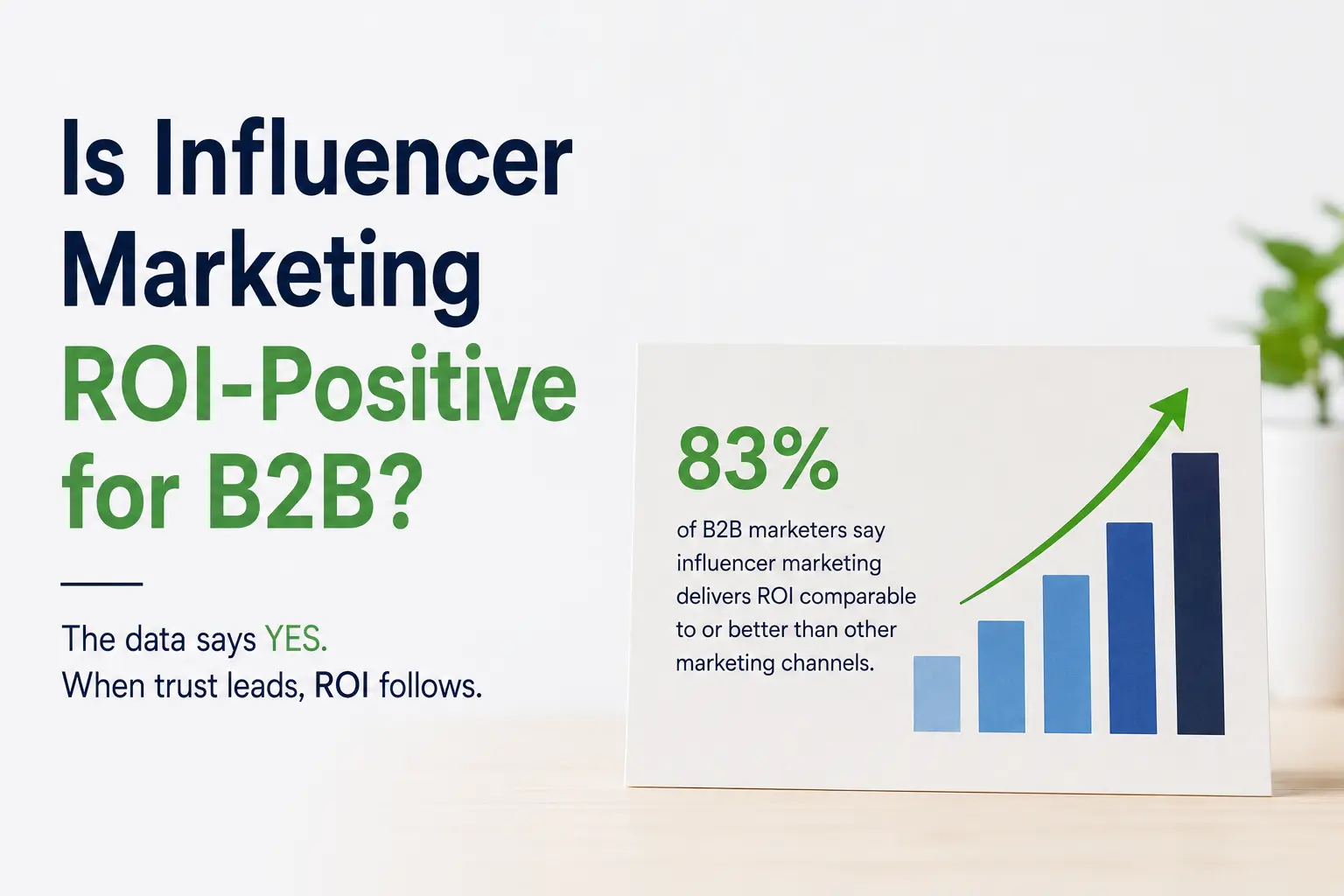
- Positive sentiment is high. The large majority of B2B marketers report that influencer marketing delivers results equal to or better than other channels they run.
- Reported ROI multiples are strong. Independent benchmark studies commonly cite average returns in the range of roughly $5 to $6.50 earned per $1 spent on B2B influencer campaigns though methodologies vary widely between reports, so treat any single figure as directional rather than gospel.
- B2B is the fastest-growing subcategory of influencer marketing, expanding well ahead of the broader creator economy as brands shift budget from paid social toward creator-led content.
- Trust drives the return. A large share of B2B buyers say they trust recommendations from subject-matter experts and industry voices more than branded content, which is the underlying mechanism behind the ROI not the influencer’s follower count.
Because measurement standards differ so much between vendors, the honest takeaway isn’t “influencer marketing returns exactly $X” it’s that the channel consistently outperforms its cost when it’s tied to a defined funnel stage and tracked past vanity metrics.
Why B2B Influencer Marketing Works When It’s ROI-Positive
1. It borrows trust, not just reach
B2B buying committees are skeptical of vendor claims. A respected analyst, practitioner, or niche creator vouching for a product shortcuts the credibility-building that sales and content teams otherwise have to do manually.
2. Micro and niche creators outperform on efficiency
In B2B, follower count matters far less than relevance. Creators with smaller, highly specific audiences (a cybersecurity practitioner, a finance leader, a supply-chain voice) typically produce better engagement and lower cost-per-lead than broad-reach influencers, because the audience overlap with your actual buyer is much tighter.
3. LinkedIn has become the primary B2B distribution layer
LinkedIn’s scale and professional context make it the default channel for B2B creator content, and posts from credible industry voices tend to substantially outperform brand-published posts on the same platform.
4. Multi-touch attribution finally makes ROI provable
More mature programs now track influencer activity against MQLs, SQLs, and pipeline influence rather than likes and shares — which is what separates teams that can prove ROI from teams that only feel like the channel is working.
Where B2B Influencer Marketing ROI Breaks Down
ROI isn’t automatic. Programs underperform when:
- Measurement stops at impressions. Reach and engagement without a defined conversion path make ROI impossible to calculate.
- Influencer selection is reach-driven, not relevance-driven. A large following in the wrong industry produces noise, not pipeline.
- There’s no clear CTA or landing experience. Awareness content without a next step wastes the trust the influencer just built.
- Attribution is neglected. Without UTM tracking, unique landing pages, or CRM tagging, teams end up guessing at influence rather than measuring it.
How to Measure B2B Influencer Marketing ROI
- Define the KPI before launch — awareness (reach, share of voice), consideration (MQLs, content engagement), or revenue (SQLs, pipeline, closed-won).
- Use trackable links and landing pages per influencer and per campaign.
- Tag leads in your CRM by source so influencer-driven pipeline is visible in the same reporting as paid and organic.
- Calculate cost per outcome, not cost per post — divide total campaign spend by qualified leads or pipeline generated, not by impressions.
- Compare against your other channels’ benchmarks so “ROI-positive” means something relative to what you’re already spending on paid or content marketing.
The Bottom Line
B2B influencer marketing is ROI-positive for companies that treat it as a measurable demand-generation channel, not a brand-awareness experiment. The returns reported across the industry are genuinely strong, but they cluster around programs with tight creator-audience fit, defined KPIs, and attribution built in from day one. Run it that way, and the data suggests it will outperform most other channels in your mix. Run it as a reach play with no measurement plan, and you’ll have no way to prove it worked either way.
FAQ
1.What is a good ROI benchmark for B2B influencer marketing?
Reported industry averages commonly fall between $5 and $6.50 returned per $1 spent, though this varies by industry, influencer tier, and measurement methodology.
3.What’s the biggest reason B2B influencer campaigns fail to show ROI?
Weak or missing attribution — measuring engagement instead of pipeline is the most common gap marketers report.