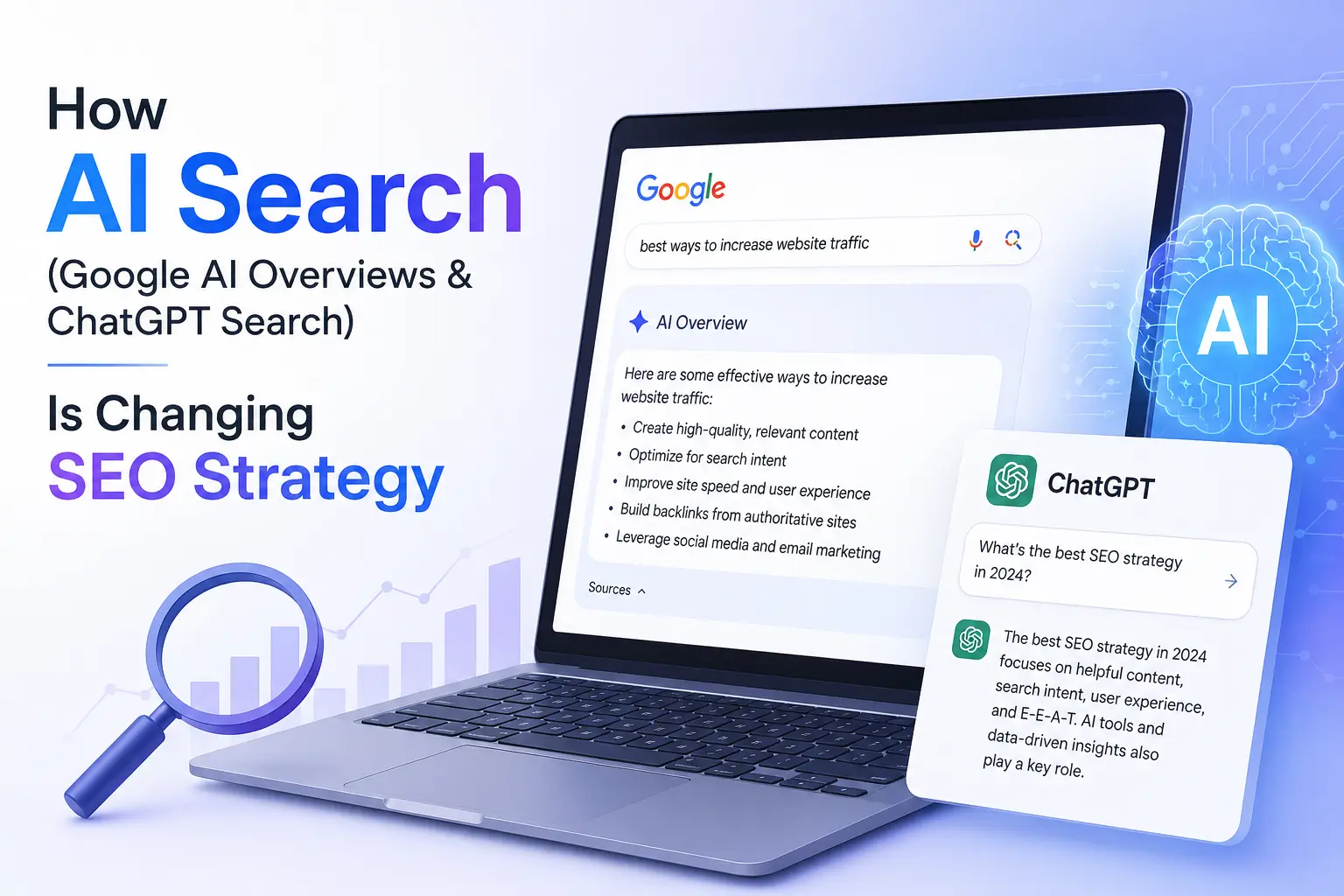
How AI Search (Google AI Overviews & ChatGPT Search) Is Changing SEO Strategy
For two decades, SEO ran on a simple premise: rank in the top ten blue links, and the clicks will follow. That premise is breaking down. Google now answers a large share of queries directly on the results page through AI Overviews, ChatGPT Search lets users research and buy without ever opening a browser tab, and Perplexity and Microsoft Copilot are carving out their own slices of discovery traffic.
For businesses and marketers, this isn’t a minor algorithm update it’s a structural shift in how people find information and how visibility gets measured. Rankings still matter, but they’re no longer the whole story. Being cited inside an AI answer, being mentioned by a language model, and being trusted enough to earn a click when one is offered now matter just as much.
This guide breaks down what AI search actually is, why it’s reshaping SEO, and exactly what to do about it from content strategy and E-E-A-T to technical SEO and the emerging discipline of Generative Engine Optimization (GEO).
What Is AI Search?
Understanding AI-Powered Search Engines
“AI search” isn’t one product it’s a category that includes several overlapping tools:
- Google AI Overviews – AI-generated summaries that appear above traditional search results, synthesizing information from multiple sources into a single answer with inline citations.
- ChatGPT Search – OpenAI’s search-enabled mode, which lets ChatGPT pull live web results into a conversational answer, complete with source links.
- Microsoft Copilot – Microsoft’s AI assistant, built into Bing and Windows, blending chat-based answers with traditional search.
- Perplexity AI – An “answer engine” built from the ground up around cited, conversational search results rather than a list of links.
Each tool works differently under the hood, but they share a common goal: give the user a synthesized answer instead of a list of pages to sort through themselves.
How AI Search Differs from Traditional Search
Search results vs. AI-generated answers. Traditional search returns a ranked list of pages and leaves interpretation to the user. AI search does the reading for them, generating a direct answer and citing a handful of sources as support.
Conversational search experience. Instead of typing fragmented keywords, users now ask full questions and follow up conversationally “What’s the best CRM for a 10-person sales team?” followed by “Which of those integrates with HubSpot?”
Reduced reliance on keyword matching. AI systems interpret intent and meaning (semantic search) rather than matching exact strings. A page optimized purely around keyword density has less to offer a model that’s trying to understand and synthesize a topic.
Why AI Search Is Transforming SEO
AI-assisted search has moved from experimental to mainstream faster than most SEOs expected. Industry data suggests AI Overviews now appear in roughly a third to half of all Google search queries in the U.S., with informational and how-to queries triggering them well over half the time. Adoption is still climbing as Google rolls the feature into more query types and markets.
That growth has changed user behavior in a measurable way. People increasingly get their answer directly on the results page and never click through the so-called “zero-click search” phenomenon. Multiple large-scale studies tracking billions of search impressions have found that organic click-through rates on queries with an AI Overview present are substantially lower than on queries without one, particularly for top-ranking pages that once absorbed most of the clicks. Some publishers have reported organic traffic declines in the double digits since AI Overviews rolled out.
The upside: sources that are cited inside an AI Overview tend to see stronger click quality, and citation patterns are becoming more predictable pages with sustained topical authority are earning steadier placement than they did in the feature’s early, volatile days. In other words, visibility is being redistributed, not eliminated. The businesses that adapt their strategy are the ones capturing what’s left of that redistributed attention.
Key Ways AI Search Is Changing SEO Strategy
1. Search Intent Is More Important Than Keywords
Focus on solving user problems. AI models reward content that actually resolves the question behind the query, not content built around a target keyword. Write to answer the “why” someone is searching, not just the “what.”
Semantic search and natural language. Because AI systems interpret meaning rather than matching strings, content should read naturally and cover a topic’s full context related subtopics, common follow-up questions, and the terminology real users use in conversation.
2. Content Quality Takes Priority
Helpful, comprehensive content. Thin pages that skim the surface of a topic rarely get cited. AI systems tend to pull from pages that thoroughly answer a question in one place.
Original insights and expertise. Google’s own guidance on AI search draws a clear line between “commodity content” generic advice anyone could write and content built on direct, first-hand experience that offers something not already said a hundred times elsewhere. That distinction increasingly determines what gets cited and what gets ignored.
Avoiding thin and duplicate content. Pages that repeat what’s already well-established elsewhere on the web add little value to a model that’s already synthesizing from dozens of similar sources.
3. E-E-A-T Matters More Than Ever
Google’s E-E-A-T framework Experience, Expertise, Authoritativeness, Trustworthiness has become even more central in an AI-driven results page, since the model is making an implicit judgment about which sources are safe to summarize and cite.
- Experience – First-hand, demonstrable knowledge of the subject (having actually used the product, run the process, or lived the situation).
- Expertise – Credentialed or demonstrated depth of knowledge in the subject area.
- Authoritativeness – Recognition from other credible sources, sites, and experts in the field.
- Trustworthiness – Accuracy, transparency, and a track record that supports confident citation.
4. Topical Authority Beats Individual Rankings
Ranking one page for one keyword is a much weaker signal than owning a topic end to end. AI systems tend to favor sites that clearly demonstrate depth across a subject.
- Topic clusters – Groups of related content organized around a core theme.
- Pillar pages – A comprehensive, central page that anchors a cluster and links out to supporting content.
- Internal linking strategy – A deliberate linking structure that signals topical relationships to both users and crawlers.
5. Conversational Content Performs Better
Writing in a natural tone. Content that reads like a knowledgeable person explaining something not like a keyword-stuffed landing page aligns better with how conversational AI systems parse and reuse language.
Answering complete questions. Structure sections around full questions (“How much does X cost?” rather than just “X cost”) so the content maps directly onto how users query AI tools.
Using FAQs effectively. FAQ sections, when genuinely useful rather than padded for schema markup, give AI systems compact, quotable answers to common follow-up questions.
Optimizing for Google AI Overviews
How AI Overviews Select Content
AI Overviews are built by identifying queries where a synthesized answer is more useful than a list of links, then selecting from a mix of sources based on:
- Relevance – How directly the content answers the specific query.
- Authority – The site’s established credibility and E-E-A-T signals.
- Freshness – Whether the content reflects current, up-to-date information.
- Structured information – Clear formatting that makes content easy to extract and summarize.
It’s worth noting that citation overlap with the traditional top-10 organic results has weakened significantly meaning a page doesn’t need to rank #1 to be cited, but it does need to be structured and authoritative enough for the system to trust and extract from it.
Best Practices
- Clear headings – Use descriptive H2s and H3s that mirror real user questions.
- Short answer summaries – Lead sections with a concise, direct answer before expanding into detail.
- Schema markup – While Google has said structured data isn’t strictly required for AI features, it remains a solid signal as part of a broader technical SEO strategy.
- Mobile optimization – A majority of AI Overview impressions happen on mobile, where summaries take up more screen real estate.
- Fast page speed – Slow pages are less likely to be crawled, indexed, and trusted for extraction.
Optimizing for ChatGPT Search
How ChatGPT Search Evaluates Content
ChatGPT Search leans heavily on:
- Reliable sources – Established, well-sourced publishers and sites with a track record.
- Brand credibility – Recognition and consistent presence across the web, not just on-site signals.
- Context-rich information – Content that provides enough surrounding context to be safely summarized without distortion.
Best Practices
- Publish expert content – Bylined, credentialed, experience-backed writing performs better than anonymous or generic posts.
- Maintain consistent branding – Consistent naming, messaging, and information across your site and third-party mentions helps models resolve who you are.
- Keep content updated – Stale pages are less likely to be trusted for current information.
- Earn mentions and backlinks – Being referenced across other credible sites strengthens the trust signals AI systems rely on.
Technical SEO Still Matters
AI search hasn’t made technical SEO optional if anything, it’s raised the floor. A page can be the best-written answer on the internet and still be invisible if it isn’t crawlable.
- Core Web Vitals – Loading speed, interactivity, and visual stability.
- Mobile-first design – Since indexing and much of AI Overview consumption is mobile-first.
- HTTPS security – A baseline trust and ranking signal.
- XML sitemaps – Help search engines and AI crawlers discover and index content efficiently.
- Structured data (Schema.org) – Supports rich results and helps machines parse page content accurately.
- Crawlability and indexability – If AI systems and their underlying crawlers can’t access a page, none of the content strategy above matters.
GEO (Generative Engine Optimization): The Next Evolution of SEO
What Is GEO?
Generative Engine Optimization is the practice of optimizing content specifically to be found, understood, and cited by generative AI systems Google AI Overviews, ChatGPT Search, Perplexity, and similar tools rather than optimizing purely for ranking position in a traditional results list.
GEO vs. Traditional SEO
Traditional SEO optimizes for ranking position: the goal is to appear as high as possible in a list of links. GEO optimizes for citation and synthesis: the goal is to be the source an AI model chooses to pull from, quote, or reference when constructing its answer. The two goals overlap heavily authority, quality, and technical health matter to both but GEO adds new priorities, like structuring content in extractable, quotable chunks and building a broader footprint of credible mentions across the web that a model might draw on beyond your own site.
How to Optimize for AI-Generated Search Results
- Structure content around direct, complete-question answers near the top of each section.
- Build genuine topical depth rather than isolated, keyword-targeted pages.
- Invest in original data, first-hand experience, and unique perspectives that can’t be found verbatim elsewhere.
- Maintain a consistent, citable brand presence across third-party sites, forums, and publications not just your own domain.
- Keep content current, since freshness is a recurring factor in what gets selected for synthesis.
Common SEO Mistakes in the AI Search Era
- Keyword stuffing – A holdover tactic that actively works against semantic, intent-based ranking systems.
- Publishing AI-generated content without review – Unedited, unverified AI output tends to be generic and erodes the experience-based signals AI systems are trained to look for.
- Ignoring user intent – Optimizing for a search term instead of the question behind it.
- Neglecting technical SEO – Assuming great content alone is enough, while crawlability and site health quietly cap visibility.
- Failing to update outdated content – Stale pages lose ground to fresher, more current sources in both traditional rankings and AI citations.
Actionable Checklist for AI-Ready SEO
- Research user intent before writing start from the question, not the keyword.
- Build topic clusters around pillar pages instead of isolated posts.
- Create original, experience-based content that reflects direct knowledge.
- Strengthen E-E-A-T signals (author bios, credentials, citations, transparency).
- Add genuinely useful FAQs and relevant structured data.
- Improve page speed and mobile usability.
- Monitor AI search visibility (citations and mentions) alongside traditional organic performance.
The Future of SEO in an AI-Driven World
Emerging AI search trends. Expect AI Overviews and AI-mode experiences to keep expanding into more query types and markets, citation patterns to keep stabilizing around consistently authoritative sources, and competition for AI visibility to intensify as more brands adapt their content strategy.
The role of human expertise. As AI-generated content becomes commoditized, first-hand human experience and expertise become more valuable, not less it’s precisely the kind of “non-commodity” insight that generic AI output can’t replicate and that both users and AI systems are being steered toward.
Why quality content remains the foundation of SEO. Every optimization tactic discussed here technical SEO, E-E-A-T, topical authority, GEO is in service of the same underlying goal SEO has always had: being the most useful, trustworthy source on a given topic. AI search has changed how that usefulness gets discovered and surfaced, not the fact that it’s the thing being rewarded.
Conclusion
AI search isn’t a passing trend it’s a fundamental shift in how people find and consume information, and it’s already reshaping the mechanics of SEO: less emphasis on exact keyword matching and single-page rankings, more emphasis on intent, topical depth, E-E-A-T, and being a source AI systems trust enough to cite. Traditional SEO fundamentals technical health, quality content, credible signals haven’t gone away; they’ve become the entry ticket for a new layer of optimization on top.
Businesses that focus now on helpful, trustworthy, user-centric content and treat GEO as an extension of SEO rather than a replacement for it will be better positioned for visibility in both traditional search results and the AI-generated answers increasingly standing in front of them. The websites that adapt today will have a real head start on long-term visibility, no matter how the specific tools and algorithms continue to evolve.
1. What is AI search, and how is it different from traditional search?
AI search refers to tools like Google AI Overviews, ChatGPT Search, Microsoft Copilot, and Perplexity AI that generate direct, synthesized answers to a query instead of just returning a list of links. Traditional search leaves the user to click through and interpret results themselves; AI search does much of that synthesis up front.
2. How does Google AI Overviews affect website traffic?
Multiple industry studies show that organic click-through rates tend to drop on queries where an AI Overview appears, particularly for pages that previously ranked in the top position, since many users get their answer without clicking through. However, sites that are cited within an AI Overview can see strong click quality from the traffic they do receive.
3. Can websites still rank well in AI-powered search results?
Yes. Citation patterns are increasingly favoring sites with genuine topical authority, strong E-E-A-T signals, and well-structured, up-to-date content. Ranking in the traditional top 10 is no longer a guarantee of citation, but authoritative, well-optimized sites are still consistently featured.
4. What is Generative Engine Optimization (GEO)?
GEO is the practice of optimizing content specifically to be understood, extracted, and cited by generative AI systems, rather than optimizing purely for position in a traditional ranked list of links. It builds on traditional SEO fundamentals while adding a focus on extractable structure and cross-web credibility.
5. How can I optimize my content for ChatGPT Search?
Focus on publishing expert, well-sourced, and consistently branded content, keep information current, and build credibility through mentions and backlinks across other reputable sites ChatGPT Search leans heavily on source reliability and brand recognition.
6. Is traditional SEO still relevant in 2026?
Yes. Technical SEO, quality content, and E-E-A-T remain the foundation that AI search visibility is built on. AI search adds new layers of optimization on top of these fundamentals it doesn’t replace them.