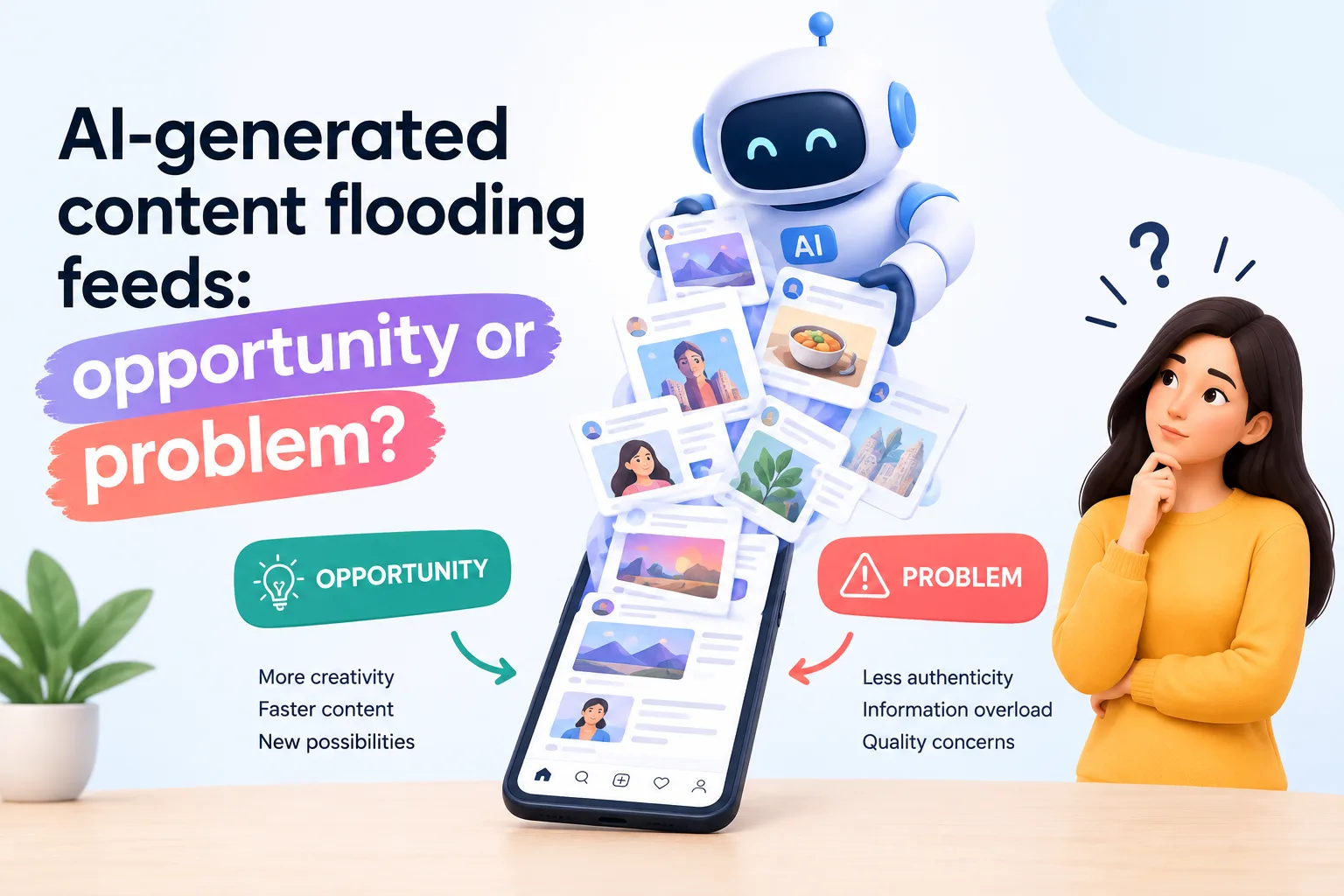
AI-Generated Content Flooding Feeds: Opportunity or Problem?
Open any social platform today and you’ll notice something: the feed feels different. Articles read a little too polished. Images look almost real but not quite. Comment sections have replies that seem to appear within seconds of a post going live. This is the visible edge of a much larger shift AI-generated content is flooding feeds at a scale never seen before, and it’s forcing creators, marketers, and platforms to rethink what “content” even means.
Is this flood an opportunity for scale and efficiency, or a problem that’s eroding trust and originality online? The honest answer is: both depending on how it’s used.
What Is AI-Generated Content, Exactly?
AI-generated content refers to text, images, video, audio, or code produced primarily by artificial intelligence tools rather than a human working from scratch. This includes:
- Blog posts and articles written by large language models
- AI-generated images and video (from tools capable of producing photorealistic visuals)
- Auto-generated product descriptions and social captions
- AI voiceovers, music, and synthetic media
- Bot-driven comments and engagement on social platforms
The technology has moved fast. What used to require a full production team can now be generated in seconds, which is exactly why volume has exploded.
Why Feeds Are Being Flooded With AI-Generated Content
A few forces are driving this surge:
- Low cost of production – Generating content with AI is dramatically cheaper than hiring writers, designers, or videographers.
- Speed at scale – Brands and creators can publish dozens of pieces per day instead of one per week.
- Algorithmic rewards – Many platforms still reward posting frequency and engagement, incentivizing high-volume publishing regardless of quality.
- Low barrier to entry – Anyone with an idea and an AI tool can now produce content that once required specialized skills.
The result is a feed environment where human-made and AI-generated content sit side by side, often indistinguishable at a glance.
The Opportunity Side of AI-Generated Content
It’s easy to focus on the downsides, but AI-generated content brings real value when used thoughtfully.
1. Democratized Content Creation
Small businesses and independent creators who couldn’t previously afford design or writing teams can now produce professional-looking content. This levels the playing field against larger, well-funded competitors.
2. Faster Ideation and Drafting
Writers and marketers use AI to speed up outlining, research summarization, and first drafts freeing up time for strategy, editing, and the human judgment that AI still can’t replicate.
3. Personalization at Scale
AI can tailor content variations for different audience segments different tones, languages, or formats something manual production could never keep pace with.
4. Accessibility Improvements
AI-generated captions, transcripts, and alt text make content more accessible to people with disabilities, often automatically.
The Problem Side of AI-Generated Content
The flood has real costs, too and they’re becoming harder to ignore.
1. Content Saturation and Noise
When feeds are full of AI-generated content, genuinely valuable posts get buried. Readers are spending more time filtering out filler content just to find something worth reading.
2. Declining Trust
Once audiences suspect content is AI-generated without disclosure, they start questioning everything including content that is human-made and accurate. This “trust tax” affects everyone, not just the bad actors.
3. Misinformation Risk
AI can generate convincing but false or misleading content at a pace fact-checkers can’t match, particularly around breaking news and sensitive topics.
4. Homogenized Style and Ideas
Because many AI tools draw from similar training patterns, large volumes of AI-generated content can start to sound the same reducing the diversity of voice and perspective online.
5. SEO and Platform Penalties
Search engines and social platforms are actively adjusting algorithms to detect and demote low-effort, mass-produced AI content, which can hurt creators who rely on volume-based strategies.
How to Use AI-Generated Content Responsibly
Rather than treating this as an all-or-nothing debate, most successful creators and brands are landing on a middle path:
- Use AI as a drafting tool, not a publishing tool. Human review, fact-checking, and editing should happen before anything goes live.
- Disclose AI involvement when it’s substantial. Transparency builds trust rather than eroding it.
- Prioritize originality over volume. One well-researched, human-edited piece often outperforms ten generic AI posts.
- Add first-hand experience and expertise. This is increasingly what separates content that ranks and resonates from content that gets ignored.
- Monitor platform guidelines. Search engines and social networks are updating policies on AI content regularly staying compliant protects visibility.
The Bottom Line
AI-generated content flooding feeds isn’t inherently good or bad it’s a tool whose impact depends entirely on intent and execution. Used carelessly, it drowns out authentic voices, damages trust, and clutters the internet with low-value noise. Used strategically as a support tool alongside human expertise, editing, and originality it becomes a genuine opportunity to create more accessible, personalized, and efficient content.
The creators and brands who will win in this new landscape aren’t the ones producing the most AI-generated content. They’re the ones using AI to produce better content, faster, without losing the human judgment that makes content worth reading in the first place.
FAQs
Is AI-generated content bad for SEO?
Not inherently. Search engines penalize low-quality, unhelpful content regardless of whether it’s AI-generated or human-written. Well-edited, valuable AI-assisted content can rank well.
Should I disclose when I use AI to create content?
Transparency is increasingly expected by audiences and, in some cases, required by platform policy or regulation. When AI plays a substantial role, disclosure builds trust.
Will AI-generated content replace human writers?
It’s replacing certain repetitive, high-volume tasks, but human expertise, judgment, and original insight remain difficult for AI to fully replicate and audiences increasingly value them.
Is AI-generated content bad for SEO? Not inherently. Search engines penalize low-quality, unhelpful content — regardless of whether it’s AI-generated or human-written. Well-edited, valuable AI-assisted content can rank well.
Should I disclose when I use AI to create content? Transparency is increasingly expected by audiences and, in some cases, required by platform policy or regulation. When AI plays a substantial role, disclosure builds trust.
Will AI-generated content replace human writers? It’s replacing certain repetitive, high-volume tasks, but human expertise, judgment, and original insight remain difficult for AI to fully replicate — and audiences increasingly value them.